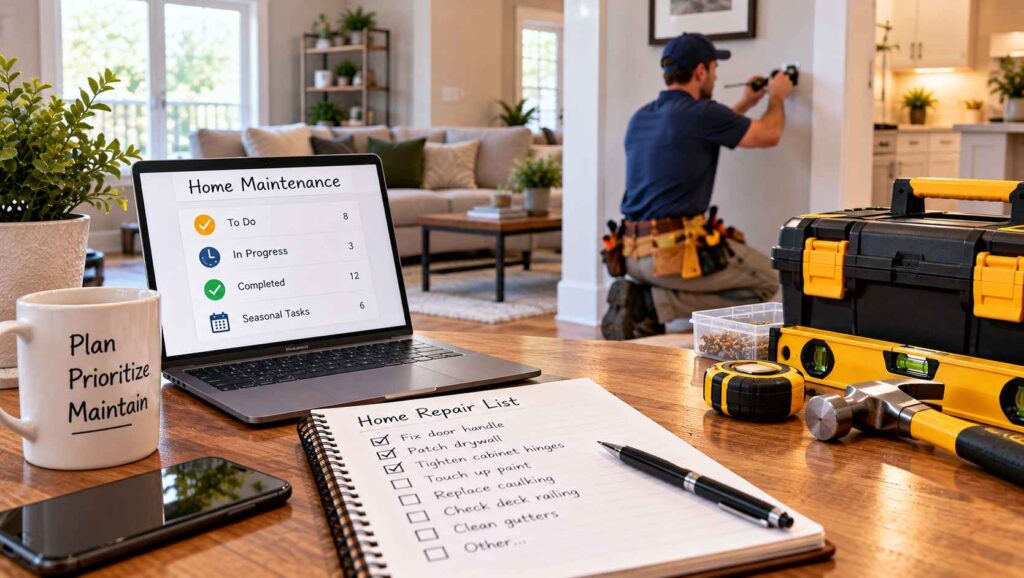

For homeowners with demanding work schedules, family responsibilities, and packed calendars, routine home maintenance can easily move to the bottom of the list. A loose handle can wait another week. A sticking door becomes something everyone works around. A small patch of damaged drywall stays untouched because there never seems to be a convenient afternoon to fix it.
The problem is not necessarily that these tasks are difficult. It is that small jobs compete with everything else that needs attention.
A more efficient approach is to treat home maintenance like any other recurring responsibility: keep track of it, prioritize it, schedule it, and decide realistically which tasks are worth handling yourself.
Keep One Running Repair List
The first step is to stop relying on memory.
When a homeowner notices a small issue, it is easy to think, “I’ll take care of that later.” By the time later arrives, several more repairs may have been added.
A simple digital note, spreadsheet, or household maintenance app can solve much of this problem.
Record the issue as soon as it is noticed. Instead of writing “fix door,” be specific: “bedroom door sticks near the top of the frame.” Instead of “wall needs work,” note the room and the type of damage.
Specific descriptions make the list easier to review and act on.
The goal is not to create an elaborate property-management system. It is simply to have one reliable place where household repairs can be captured before they are forgotten.
Separate Urgent Tasks From Routine Work
Not every repair deserves the same priority.
A useful maintenance list should distinguish between issues that need prompt attention and those that can reasonably wait.
Safety concerns, active water problems, significant damage, or issues affecting important household functions should generally be considered before cosmetic improvements.
A loose decorative trim piece and a problem involving water entering a finished area should not compete for the same position on the list.
The same principle applies to functional problems. A door that no longer closes properly may deserve attention before a small paint scuff because it affects how the home is used.
This simple distinction can make a long list feel much more manageable.
Use a Short Weekly Review
Busy homeowners do not necessarily need a dedicated maintenance day every weekend.
A short review once a week or every couple of weeks can be enough to keep the list under control.
Take a few minutes to look at outstanding tasks and ask three questions:
What needs attention soon?
What can wait?
What can be grouped with another task?
This prevents the repair list from becoming something that is only reviewed when a problem becomes impossible to ignore.
A regular review also makes it easier to notice recurring problems before they become forgotten background issues.
Group Similar Jobs Together
Efficiency often comes from reducing the number of separate tasks.
If several rooms need minor repairs, consider whether some can be handled during the same maintenance session.
For example, several loose cabinet handles, door adjustments, small trim repairs, or minor finishing jobs may be more efficient to address together than individually.
The same applies to shopping for materials.
Instead of making several trips for individual repairs, homeowners can review the list first and determine which supplies are actually needed.
Grouping jobs does not mean every repair has to be completed immediately. It simply helps reduce unnecessary repetition.
Schedule Around Your Actual Calendar
One of the biggest mistakes busy homeowners make is creating a maintenance plan based on free time they do not realistically have.
If weekdays are already full and weekends are frequently occupied, assuming that several hours will suddenly become available is unlikely to work.
Instead, look at the calendar honestly.
Some homeowners may have a short window on a particular evening. Others may prefer to reserve one morning every few weeks for household tasks.
The schedule does not need to be rigid.
The important thing is to assign maintenance tasks to real blocks of available time rather than leaving them in an indefinite “I’ll get to it” category.
Build Seasonal Maintenance Into the Routine
Seasonal changes provide natural reminders to review different parts of the home.
Before colder weather, homeowners may want to look at exterior doors, visible caulking, weather-related wear, and other areas that may be affected by winter conditions.
After winter, exterior finishes, steps, railings, trim, and other exposed areas can be reviewed for signs of wear.
The exact checklist will vary depending on the property.
The benefit of a seasonal review is that it creates a predictable opportunity to notice issues instead of waiting for them to become inconvenient.
Adding these checks to an existing calendar can make them easier to remember.
Watch for Recurring Problems
A repair that keeps coming back deserves more attention than a one-time cosmetic defect.
If a door repeatedly becomes difficult to close, a section of trim keeps coming loose, or a particular area repeatedly develops damage, record what is happening.
The objective is not to assume that a recurring problem is serious.
It is to avoid repeatedly addressing the visible symptom without considering whether there is another reason the issue keeps returning.
A maintenance record can be surprisingly useful. If the same problem has appeared several times, the history gives a homeowner more information to work with when deciding what should happen next.
Be Selective About DIY Projects
Doing basic maintenance yourself can be satisfying and practical when the task is appropriate for your skills, tools, and available time.
But “small” does not always mean “simple.”
A repair may require more preparation than expected, or the underlying issue may be different from what is visible.
Homeowners should also be particularly cautious with electrical, gas, structural, complex plumbing, and other specialized work. These tasks can involve safety considerations and may require appropriately qualified professionals.
Knowing when to stop a DIY project is just as useful as knowing when to start one.
A realistic maintenance system should account for the homeowner’s abilities rather than assuming every repair should be handled personally.
Know When Outsourcing Saves Time
Time is a resource just like money.
A homeowner may be technically capable of completing several small repairs but still decide that doing them personally is not the best use of a limited schedule.
This is especially true when the list contains unrelated jobs that require different tools, materials, preparation, and skills.
When several household repairs have accumulated, using Gillespie Handyman for home repair support can be one practical option for Ottawa homeowners who want to deal with routine work rather than repeatedly carrying the same unfinished tasks forward.
The decision does not have to be all-or-nothing. A homeowner might handle straightforward maintenance personally while getting appropriate assistance with tasks that require more time, equipment, or experience.
Keep Basic Repair Records
A simple record of completed maintenance can make future planning easier.
For each significant repair, note what was done and approximately when it was completed.
This is particularly useful for recurring maintenance or issues that may need attention again later.
Records can also prevent homeowners from forgetting what has already been repaired.
A basic spreadsheet might include the date, area of the home, task, materials used, and whether follow-up is required.
There is no need to turn it into a complicated administrative project. A few useful notes can provide enough information to make future decisions easier.
Avoid Treating Every Imperfection as a Priority
Busy homeowners can also save time by accepting that not every imperfection needs immediate attention.
Homes naturally show signs of everyday use.
A small scratch, minor paint mark, or slightly worn finish may be perfectly reasonable to leave until a convenient time.
Trying to maintain every surface in perfect condition at all times can create unnecessary work.
Instead, distinguish between deterioration that affects function or could reasonably lead to further problems and ordinary cosmetic wear.
This keeps maintenance practical rather than turning it into a constant source of unfinished projects.
Create a Monthly Maintenance Reset
A monthly reset can bring the entire system together.
Set aside a short period to review the current list.
Remove completed tasks. Add newly noticed repairs. Reconsider priorities. Group related jobs. Identify anything that needs professional attention.
Then choose only a realistic number of tasks for the coming month.
This final point matters.
A list of twenty tasks may be accurate, but assigning all twenty to the next month does not make the plan more effective. It simply creates another backlog.
A shorter list that is actually completed is much more useful.
Make the System Fit Your Lifestyle
There is no single correct maintenance schedule for every homeowner.
Someone who works from home may be able to handle small repairs during short breaks. A family with young children may prefer to reserve maintenance for specific weekends. A homeowner with frequent travel may need a more consolidated approach.
The system should fit the household rather than creating another source of stress.
The basic principles remain the same: record problems, prioritize them, group related tasks, schedule realistic time, and get appropriate help when a repair falls outside your skills or available schedule.
Keep Small Repairs From Becoming a Permanent To-Do List
Home maintenance does not have to consume every free weekend.
The biggest improvement often comes from replacing an informal approach with a simple system.
Keep one running list. Separate urgent concerns from cosmetic work. Review it regularly. Use seasonal reminders. Group similar repairs together and be honest about which projects are worth doing yourself.
When the list becomes too long, getting appropriate assistance can also be a practical time-management decision rather than a sign that a homeowner cannot handle the work.
A well-maintained home is not one where every minor imperfection is immediately corrected. It is one where important issues are noticed, priorities are clear, and routine work is dealt with in a way that fits the realities of everyday life.